So I think most of the media hoopla has died down over this. Its kinda weird when something practically in your backyard garners national attention.
Anyways, I wasn't terribly interested in this particular story as hugely problematic issue. I think it is just a bunch of teenagers getting upset and offended over really nothing. "ZOMG! He's wearing a flag! He must be disrespecting >ME<" as if the world revolved around themselves.
But what >I< did find rather offensive was one particular student. One of the "American" flags that one student was wearing was an image of multiple flags, including the American flag, on the back, and the confederate flag on the front.
Why is the confederate flag a symbol of patriotism? Its a symbol of a failed cessationist movement that threatened to DESTROY America in Civil War. A cessationist movement sparked over and largely motivated by the desire to enslave people. If you're going to pick a symbol that would represent your patriotism, then I'd humbly suggest that you pick a different symbol.
Worst yet, it doesn't even seem to give with the social rhetoric that people often tout. Love America or leave it. The south apparently didn't LOVE America so they tried to leave it. So waving the confederate flag suggests that one doesn't love America.
Now, I'm sure some would say that there is a certain patriotic overtone to the the confederate flag. The American ethos of forging ahead, doing thing differently, independent spirit. But we don't celebrate our failures. We don't hoist up for all to see DDT and exclaim, Forging ahead! Independent Spirit!
Perhaps its a symbol of Southern culture? I'm not opposed to symbolizing particular sects of the our nation by a flag. Heck, each part of our nation has particular symbols that represent them. The Hollywood sign, The Golden Gate Bridge, The Empire State Building all represent subcultures of our nation. Put it on a flag, and wave it, and you've got yourself a symbol. But to pretend that the confederate flag doesn't represent a pro-slavery movement is like pretending rainbow flags show your support for rain.
Wear a peach. Wear a cotton ball. Wear a plantation house. Wear a mint julep. Wear Boss Hogg and Roscoe P. Coltrane. But don't wear the General Lee.
Monday, May 10, 2010

Saturday, May 1, 2010
Why I am not a Localvore
Here is a pretty good read on the Greening up our food, and why it may be hurting the impoverished around the world. Oddly, he doesn't make the most obvious argument for helping the impoverished world and that is simply buying food products from those that can export them. As more people become localvores, foreign farmers lose more consumers, pushing them further into poverty. Now Paarlberg is concentrating on those who are in much worse conditions, and I agree those are people we should assist first.
But this is where I start disagreeing with him. First, he says that we should bring the industrial model to Africa. Now we have tried industrial models in Africa, and they don't succeed because, infrastructure aside, its too expensive. In America we give farmers heavy subsidies to ensure a reliable income in times when crops fail because of weather, or whatever other reason. These subsidies also keep food prices artificially low, making them affordable by all (at least for the staple crops like corn and wheat).
Second, when he says that the industrial model does not create unsafe food, he seems to be focusing only on plants. With crops, he's correct. With livestock, he's incorrect. In fact, most outbreaks involving crops, are usually traced back to livestock. But he conveniently forgets this when he brings up fertilizer run-offs. Suddenly farming includes livestock again.
So what about animal manure and fertilizers? First, fertilizers and pesticides are already OVER used. If there is little financial incentive to avoid over fertilizing and over spraying, other than you're wasting product, but the product is already dirt cheap as it is, and the losses are could be significant if you UNDER fertilize and spray, farmers tend to err on the side of overuse. This is the profit first thinking that characterizes industrial food production. So his analysis that organic farming would be worse, because the amount of livestock would increase is simply flawed. First, if we simply had fewer livestock, we would have less need for cropland, since most of our cropland is devoted to feeding our livestock. Second, if we utilized manure instead of petroleum based fertilizers, industrial farmers would aim to UNDER fertilize than over fertilize, since it would be more expensive, and increase the risk of E. coli which could significantly damage their brand marketability.
But Paarlberg does bring up many good points about the green revolution in food, like organic not being particularly healthier, or safer for that matter. The industrial argiculture is becoming more green, and more efficient, as always, and in many ways this is better for the environment.
Strangely, Paarlberg doesn't suggest the easiest way that we can aid the impoverished of the world. Donate money to them. World poverty rates have dropped almost in half from the 60s to today, largely due to the work of NGOs. World poverty does not have to continue to exist. If we have been able to reduce world poverty in half in 50 years, we could eliminate it in probably 20 more years if we simply gave money, in a responsible manner, to assist them.
But this is where I start disagreeing with him. First, he says that we should bring the industrial model to Africa. Now we have tried industrial models in Africa, and they don't succeed because, infrastructure aside, its too expensive. In America we give farmers heavy subsidies to ensure a reliable income in times when crops fail because of weather, or whatever other reason. These subsidies also keep food prices artificially low, making them affordable by all (at least for the staple crops like corn and wheat).
Second, when he says that the industrial model does not create unsafe food, he seems to be focusing only on plants. With crops, he's correct. With livestock, he's incorrect. In fact, most outbreaks involving crops, are usually traced back to livestock. But he conveniently forgets this when he brings up fertilizer run-offs. Suddenly farming includes livestock again.
So what about animal manure and fertilizers? First, fertilizers and pesticides are already OVER used. If there is little financial incentive to avoid over fertilizing and over spraying, other than you're wasting product, but the product is already dirt cheap as it is, and the losses are could be significant if you UNDER fertilize and spray, farmers tend to err on the side of overuse. This is the profit first thinking that characterizes industrial food production. So his analysis that organic farming would be worse, because the amount of livestock would increase is simply flawed. First, if we simply had fewer livestock, we would have less need for cropland, since most of our cropland is devoted to feeding our livestock. Second, if we utilized manure instead of petroleum based fertilizers, industrial farmers would aim to UNDER fertilize than over fertilize, since it would be more expensive, and increase the risk of E. coli which could significantly damage their brand marketability.
But Paarlberg does bring up many good points about the green revolution in food, like organic not being particularly healthier, or safer for that matter. The industrial argiculture is becoming more green, and more efficient, as always, and in many ways this is better for the environment.
Strangely, Paarlberg doesn't suggest the easiest way that we can aid the impoverished of the world. Donate money to them. World poverty rates have dropped almost in half from the 60s to today, largely due to the work of NGOs. World poverty does not have to continue to exist. If we have been able to reduce world poverty in half in 50 years, we could eliminate it in probably 20 more years if we simply gave money, in a responsible manner, to assist them.
Thursday, April 22, 2010
4/20
Believe it or not, I've never smoked pot. Not that I'm against pot, or anything, but I'm just not the kind of person who likes to have fun by ingesting chemicals. I don't drink very much, if ever at all either.
I have my sympathies with people who want to legalize pot for medical purposes, and my suspicions about people who want to legalize pot for recreational purposes.... I'm not sure I'd vote for legalization for recreational purposes, but if it passed, I wouldn't be terribly upset over it. Heck, I wouldn't be upset at all, I just might go and buy a legal joint and join in the party that would inevitably follow.
But, I think people who advocate legalization for recreational purposes have a steep up-hill climb to face. One of the biggest hurdles is an appearance of legitimacy. Some may have some very good legitimate arguments for recreational legalization, (I'm not convinced though...) but the movement's face isn't a very good one.
Take a look at these pictures. These aren't exactly representative of the movement, but this is what many people think of when people think of legalization. In particular, look at pictures 3 and 7.
Picture 3 shows a clearly underage kid using a bong. Not exactly a responsible face to present, although I'm sure nobody was objecting to this around them. Encouraging children to smoke pot, or to do any kind of recreational drug, I think is rather irresponsible. And before supporters ask, Yes, I would say that to caffeine as well. Utilizing a drug for recreational purposes needs to have a stronger justification than its fun, in the same way as driving a Hummer is fun. Sure, there isn't likely going to be catastrophic effects from one person driving a hummer around for fun, but it begins to foster a kind of character that I'm not sure many, if anyone would call intrinsically valuable. What kind of character does it foster exactly? Look at Picture 7.
Picture 7 shows a pregnant woman at a 4/20 event. Now, it doesn't show her smoking, but second hand smoke can have adverse effects on the health of a fetus, be it tobacco or pot. I think it shows a kind of reckless disregard of consequences, in favor of the momentary pleasure. Basically, a hedonistic lifestyle.
Again, I'm not strongly against legalization for recreational use, but I think at the very least it needs a better face.
I have my sympathies with people who want to legalize pot for medical purposes, and my suspicions about people who want to legalize pot for recreational purposes.... I'm not sure I'd vote for legalization for recreational purposes, but if it passed, I wouldn't be terribly upset over it. Heck, I wouldn't be upset at all, I just might go and buy a legal joint and join in the party that would inevitably follow.
But, I think people who advocate legalization for recreational purposes have a steep up-hill climb to face. One of the biggest hurdles is an appearance of legitimacy. Some may have some very good legitimate arguments for recreational legalization, (I'm not convinced though...) but the movement's face isn't a very good one.
Take a look at these pictures. These aren't exactly representative of the movement, but this is what many people think of when people think of legalization. In particular, look at pictures 3 and 7.
Picture 3 shows a clearly underage kid using a bong. Not exactly a responsible face to present, although I'm sure nobody was objecting to this around them. Encouraging children to smoke pot, or to do any kind of recreational drug, I think is rather irresponsible. And before supporters ask, Yes, I would say that to caffeine as well. Utilizing a drug for recreational purposes needs to have a stronger justification than its fun, in the same way as driving a Hummer is fun. Sure, there isn't likely going to be catastrophic effects from one person driving a hummer around for fun, but it begins to foster a kind of character that I'm not sure many, if anyone would call intrinsically valuable. What kind of character does it foster exactly? Look at Picture 7.
Picture 7 shows a pregnant woman at a 4/20 event. Now, it doesn't show her smoking, but second hand smoke can have adverse effects on the health of a fetus, be it tobacco or pot. I think it shows a kind of reckless disregard of consequences, in favor of the momentary pleasure. Basically, a hedonistic lifestyle.
Again, I'm not strongly against legalization for recreational use, but I think at the very least it needs a better face.
Tuesday, April 20, 2010
Free Speech vs. Animal Cruelty
The Supreme Court today voted 8-1 to overturn a previous ban on animal cruelty videos because it unconstitutionally restricts free speech.
I'm not sure what to think about this. On one hand, I deeply respect the freedom of speech. On the other hand, I think that anything that supports animal cruelty should be stopped, including videos of dog fighting, cockfighting, etc.
Video depictions of cockfighting and dog fighting, encourage more of the same because if the videos sell well, then it is another source of revenue for dog fighting organizers. Much like child pornography, the more of it that is consumed, the more individuals are exploited. I would roll Bumfights into the same category. Similar to bumfights, when a particular dog becomes well known, or a successful fighter, that may create a stronger demand for videos of the dog.
But on the other hand, I'm also weary about carving out swathes of untouchable areas of the world that we do not have freedom of speech over. But, like child pornography, I think there are areas in the world that demand just that.
I like what Justice Alito says in the dissenting opinion, "The Court strikes down in its entirety a valuable statue, that was enacted not to suppress speech, but to prevent horrific acts of animal cruelty."
I'm not sure what to think about this. On one hand, I deeply respect the freedom of speech. On the other hand, I think that anything that supports animal cruelty should be stopped, including videos of dog fighting, cockfighting, etc.
Video depictions of cockfighting and dog fighting, encourage more of the same because if the videos sell well, then it is another source of revenue for dog fighting organizers. Much like child pornography, the more of it that is consumed, the more individuals are exploited. I would roll Bumfights into the same category. Similar to bumfights, when a particular dog becomes well known, or a successful fighter, that may create a stronger demand for videos of the dog.
But on the other hand, I'm also weary about carving out swathes of untouchable areas of the world that we do not have freedom of speech over. But, like child pornography, I think there are areas in the world that demand just that.
I like what Justice Alito says in the dissenting opinion, "The Court strikes down in its entirety a valuable statue, that was enacted not to suppress speech, but to prevent horrific acts of animal cruelty."
Saturday, April 17, 2010
The social costs of being vegetarian
Here's a pretty interesting interview with Melissa McEwen on Let them Eat Meat. I've posted my main objection with Melissa's position, but I also want to say, that I might be splitting hairs here, since her diet isn't one that I would particularly disagree with (it sounds like she is what Singer would call a conscientious omnivore).
Over here Pamela JSW writes that we ought not be vegetarians because of the harm it does to us! In the interview above, Melissa suggests one of the wrongs of a vegetarian diet is that it affects the family dynamic. No longer can a single dish feed the entire family, but people must bend around the individual's eating preferences. Pamela makes the same argument in her first argument.
These are the social costs of being a vegetarian. Are these enough reasons not the be a vegetarian? (I'm not suggesting here that Melissa is saying that it is. Pamela says this problem is surmountable) I think that these should be taken seriously as concerns, since they do affect lots of people (everyone you know and would like to eat with you essentially), and they affect particularly the people you care about (family and friends).
Being vegetarian is more than just choosing for yourself. Its also being accommodating of others. I'd never dream to invite myself over to a friend's house and demand a meat free meal. If I'm invited, I might expect that they would take my eating choices into consideration. But when I invite friends over, I also take their eating choices into consideration as well. That's simple politeness. Does this mean I sometimes buy meat? Yes. Not much, and not very often, but I do. Does this go counter to my personal beliefs? Yes.
But if I were a christian, and I invited someone over to my house, I wouldn't necessarily expect them to come to church with me. There is a line somewhere in the hazy sands that we must draw, but where that line is, I don't expect to have an easy answer. If my friend were Muslim and asked if she could pray while she was at my home, I wouldn't object.
Pamela's third argument however, is a little more interesting. She says that being a vegetarian may cause me to look down on others, in a moral way. Seeing most of my friends are not vegetarians makes me look at them as morally inferior, or with a defected character, which would harm the relationships that I hold with them.
Now, I don't think is an absolute. If you're a veg, or vegan that you will look down on others. I think I do it every day. Rather, instead, I think it might be indicative of a flaw in your own character, a kind of moral judgmental-ness. Instead of evaluating a person as a whole in their moral character, one fixates on simply a particular aspect of their character. Now no doubt, people can be bad people because of an aspect of their character, and ignore that aspect, they're a great person. But a wise person (since we're talking virtue theory) would be able to distinguish between acts that tarnish the whole of a person's character, versus ones that do not. I'm not sure diet is one that is, so I don't judge people based on their eating habits.
Over here Pamela JSW writes that we ought not be vegetarians because of the harm it does to us! In the interview above, Melissa suggests one of the wrongs of a vegetarian diet is that it affects the family dynamic. No longer can a single dish feed the entire family, but people must bend around the individual's eating preferences. Pamela makes the same argument in her first argument.
These are the social costs of being a vegetarian. Are these enough reasons not the be a vegetarian? (I'm not suggesting here that Melissa is saying that it is. Pamela says this problem is surmountable) I think that these should be taken seriously as concerns, since they do affect lots of people (everyone you know and would like to eat with you essentially), and they affect particularly the people you care about (family and friends).
Being vegetarian is more than just choosing for yourself. Its also being accommodating of others. I'd never dream to invite myself over to a friend's house and demand a meat free meal. If I'm invited, I might expect that they would take my eating choices into consideration. But when I invite friends over, I also take their eating choices into consideration as well. That's simple politeness. Does this mean I sometimes buy meat? Yes. Not much, and not very often, but I do. Does this go counter to my personal beliefs? Yes.
But if I were a christian, and I invited someone over to my house, I wouldn't necessarily expect them to come to church with me. There is a line somewhere in the hazy sands that we must draw, but where that line is, I don't expect to have an easy answer. If my friend were Muslim and asked if she could pray while she was at my home, I wouldn't object.
Pamela's third argument however, is a little more interesting. She says that being a vegetarian may cause me to look down on others, in a moral way. Seeing most of my friends are not vegetarians makes me look at them as morally inferior, or with a defected character, which would harm the relationships that I hold with them.
Now, I don't think is an absolute. If you're a veg, or vegan that you will look down on others. I think I do it every day. Rather, instead, I think it might be indicative of a flaw in your own character, a kind of moral judgmental-ness. Instead of evaluating a person as a whole in their moral character, one fixates on simply a particular aspect of their character. Now no doubt, people can be bad people because of an aspect of their character, and ignore that aspect, they're a great person. But a wise person (since we're talking virtue theory) would be able to distinguish between acts that tarnish the whole of a person's character, versus ones that do not. I'm not sure diet is one that is, so I don't judge people based on their eating habits.
Friday, April 16, 2010
Understanding animals, Understanding pain.
Is it really possible for us to understand an animal's experience? I'm not sure that it is. Clearly, there are classic arguments like Nagel's What is it like to be a bat, that shows that we will never know the subjective experience of having sonar from just looking at their brains. I will never know the subjective experience of giving birth. But this doesn't prevent me from understanding the pain that a woman is feeling when she is giving birth.
How do I understand this? There are two ways. 1. I can talk to her and ask her to describe what she's feeling. This is the most obvious route, but its the less used route, strangely. (Ma'am, you're currently screaming and there is a child coming out of your uterus, please rate on a scale from 1 to 10, 10 being the worst pain you've ever felt in your life, and 1 being in no pain at all, how you're feeling. Is it a sharp pain? Is it an ache?) 2. The argument by analogy. She is generally analagous to me. She has two arms, two legs, a head, etc. She yelps in pain like I do when I stub my toe. She's screaming in pain, like I would if I were experiencing something quite painful and traumatic. So she must be experiencing something quite painful and traumatic.
Both of these investigations into pain however a fundamentally flawed. The argument by analogy doesn't give us a guarantee, or even a reasonable assurance that the experiences will be similar. I've been thinking about this a lot lately, because of what my doctor told me recently. Before my MRI, my doctor said that if he suspects that I have what he thinks I have, that he would be very surprised that I'm not in more pain. Indeed, I did have what he thought I had, a herniated disc. And I was in some considerable pain, but I guess I have a rather high tolerance for pain. And so long as it isn't in my head (I use to get frequent headaches/migranes), I could deal with it. So whereas my doctor would have been exhibiting much more pain responses (moaning groaning, complaining about the pain, or whatnot), I did not. Did that mean I was experiencing less pain than he was thinking? Not necessarily.
The direct route, also is flawed. After my surgery, the nurse asked me to describe the pain that I was in, and what kind of pain I was willing to tolerate (to help gauge how much medication to give me). I said I was probably at a 6, and could tolerate an 8. She looked back at me, and said, "Remember, 10 is the worst pain you've ever experienced in your life." I said, "Yeah. This is definately not the worse pain I've experienced in life, but it definately hurts. But I could definately tolerate it." This was put to the test later, when I had physical therapy for the first time. The PT made me stand up and walk around. Its amazing how much your head weighs. My neck is in excruciating pain (even with a pre-hit of morphine). But I walked about 3x farther than the PT expected me to walk. Ask me to rate that walk on a scale of 1-10, I'd say it was about an 8. I definately didn't tolerate the walk very well, and even called my PT the "Bad Man" when he came back the next day for another round of torture (the second time included a walk all the way down the hall and back, some exercises with a fake step, and then I pushed him to let me walk up a flight of stairs).
So what did this all mean in terms of communicating my pain? Was I experiencing less pain than others? Was I more tolerant of the pain that I experienced compared to others? Both? Neither? I haven't a clue.
So if I can't understand pain of others in any meaningful way, how can I make an argument by analogy with something that doesn't share a body deisgn like mine? Does it hurt a cow when I poke him with a stick? I certainly can't ask her.
How do I understand this? There are two ways. 1. I can talk to her and ask her to describe what she's feeling. This is the most obvious route, but its the less used route, strangely. (Ma'am, you're currently screaming and there is a child coming out of your uterus, please rate on a scale from 1 to 10, 10 being the worst pain you've ever felt in your life, and 1 being in no pain at all, how you're feeling. Is it a sharp pain? Is it an ache?) 2. The argument by analogy. She is generally analagous to me. She has two arms, two legs, a head, etc. She yelps in pain like I do when I stub my toe. She's screaming in pain, like I would if I were experiencing something quite painful and traumatic. So she must be experiencing something quite painful and traumatic.
Both of these investigations into pain however a fundamentally flawed. The argument by analogy doesn't give us a guarantee, or even a reasonable assurance that the experiences will be similar. I've been thinking about this a lot lately, because of what my doctor told me recently. Before my MRI, my doctor said that if he suspects that I have what he thinks I have, that he would be very surprised that I'm not in more pain. Indeed, I did have what he thought I had, a herniated disc. And I was in some considerable pain, but I guess I have a rather high tolerance for pain. And so long as it isn't in my head (I use to get frequent headaches/migranes), I could deal with it. So whereas my doctor would have been exhibiting much more pain responses (moaning groaning, complaining about the pain, or whatnot), I did not. Did that mean I was experiencing less pain than he was thinking? Not necessarily.
The direct route, also is flawed. After my surgery, the nurse asked me to describe the pain that I was in, and what kind of pain I was willing to tolerate (to help gauge how much medication to give me). I said I was probably at a 6, and could tolerate an 8. She looked back at me, and said, "Remember, 10 is the worst pain you've ever experienced in your life." I said, "Yeah. This is definately not the worse pain I've experienced in life, but it definately hurts. But I could definately tolerate it." This was put to the test later, when I had physical therapy for the first time. The PT made me stand up and walk around. Its amazing how much your head weighs. My neck is in excruciating pain (even with a pre-hit of morphine). But I walked about 3x farther than the PT expected me to walk. Ask me to rate that walk on a scale of 1-10, I'd say it was about an 8. I definately didn't tolerate the walk very well, and even called my PT the "Bad Man" when he came back the next day for another round of torture (the second time included a walk all the way down the hall and back, some exercises with a fake step, and then I pushed him to let me walk up a flight of stairs).
So what did this all mean in terms of communicating my pain? Was I experiencing less pain than others? Was I more tolerant of the pain that I experienced compared to others? Both? Neither? I haven't a clue.
So if I can't understand pain of others in any meaningful way, how can I make an argument by analogy with something that doesn't share a body deisgn like mine? Does it hurt a cow when I poke him with a stick? I certainly can't ask her.
Wednesday, April 14, 2010
eww gross
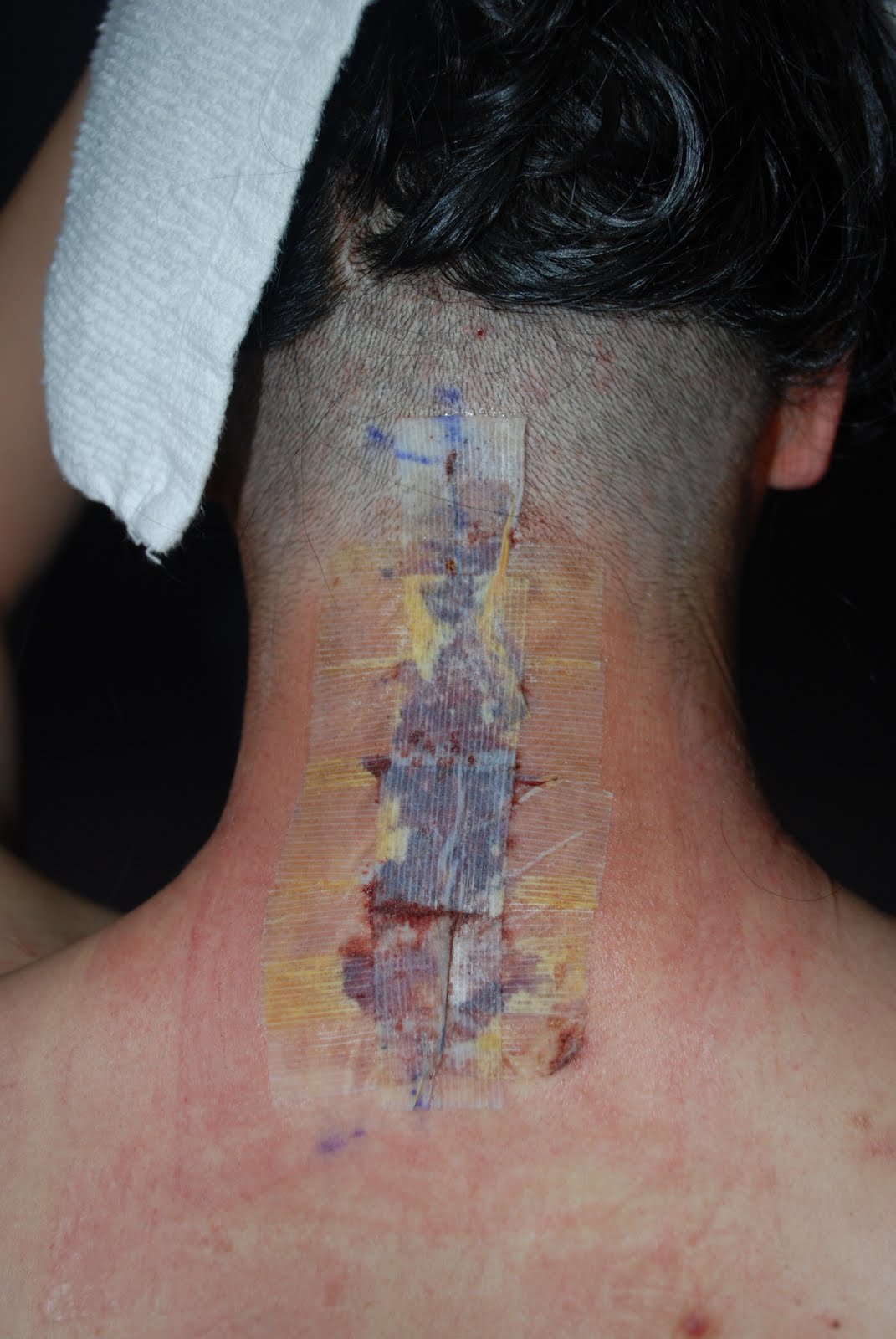
So if you want to see what I look like after the operation walking around without gauze.... click here. You don't actually see my sutures or anything, because its behind a some plastic tape and under that is blood and benzene and stuff they used to keep it from getting infected. In a couple of days I should have a better picture for you.
The picture is pretty high resolution, so you should be able to zoom into it pretty good.
The picture is pretty high resolution, so you should be able to zoom into it pretty good.
Subscribe to:
Posts (Atom)